Case Study:
Microsoft
Dynamics 365
Layout for HoloLens
Directed:
Windows Mixed Reality / First-party Apps
Functions:
UX / UI
Art & Animation
Design Operations
Video Production
Team:
10+ FTE & Contract / On-site
ABOUT HOLOLENS
The Microsoft HoloLens is a mixed reality headset that layers digital information and 3D objects onto the real world around you. Rather than replacing reality with a screen, it enhances it, letting you interact with holograms as if they were physically present in your space.

SITUATION
The HoloLens was groundbreaking technology without a validated why.
The hardware existed. The potential was undeniable. But the right people, with the right problems, had yet to be found.
As Microsoft moved the HoloLens from consumers toward enterprise, holographic space planning emerged as a real opportunity. While working prototypes existed, the real value for actual space planners was unknown.

TASK
Our team was charged with creating a mixed reality app that space planners would use every day. My job was to set a vision the team could craft into a shipped product, working closely with the internal and external partners who would ultimately bring it to life and put it to use.

ACTIONS TAKEN / Get to Know the Customer
We met with professional space planners where they work. Our partners were retailers, merchandisers, event organizers, and corporate space planners. We traveled down the street and across the country to learn their processes and observe their craft.
The key insight that changed everything: space planners don't think in positive space the way software developers do. They think in negative space, the flow between objects, because that's where people fit into the design.
Once we understood that, we had our why and we knew exactly who we were building for.
.png)
ACTIONS TAKEN / Clearly State the Vision
Once we understood our customers, we needed a One Line Concept (OLC) to align around. I drafted a why statement built around people, not platforms or features. A great OLC makes you so excited about what you'll be able to accomplish that you'll happily do what it takes to get there.
.png)
ACTIONS TAKEN / Organizing for Success
We rallied around the OLC and got to work. The team organized into cross-functional pods, with engineering, design, and QA each owning specific features like object placement and manipulation.
As creative director, I was accountable for the look, feel, and user experience of the app. We validated our work continuously, bringing industry partners in to try the application and provide direct feedback. Their input shaped everything.
.png)
ACTIONS TAKEN / Building with Intent
The deeper we got, the more we learned. As the app advanced over the next year, so did our discoveries about HoloLens best practices, from gaze, gesture, and voice interactions to the need for a standalone app to transfer designs between the headset and desktop, and support for industry standard tools.
I worked closely with my leadership peers to present our discoveries and advances to executive stakeholders. Our storytelling became a model for other HoloLens teams to follow.
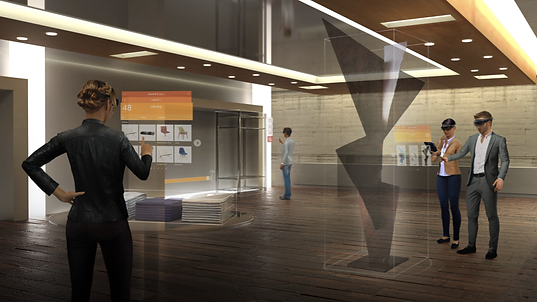.png)
RESULTS
We shipped a first. Dynamics 365 Layout became the first HoloLens workplace app to advance through Microsoft's production gates and enter wide release. The product validated the enterprise opportunity we had set out to prove, and the partnerships we built along the way became the foundation for how other HoloLens teams approached their own work.
